

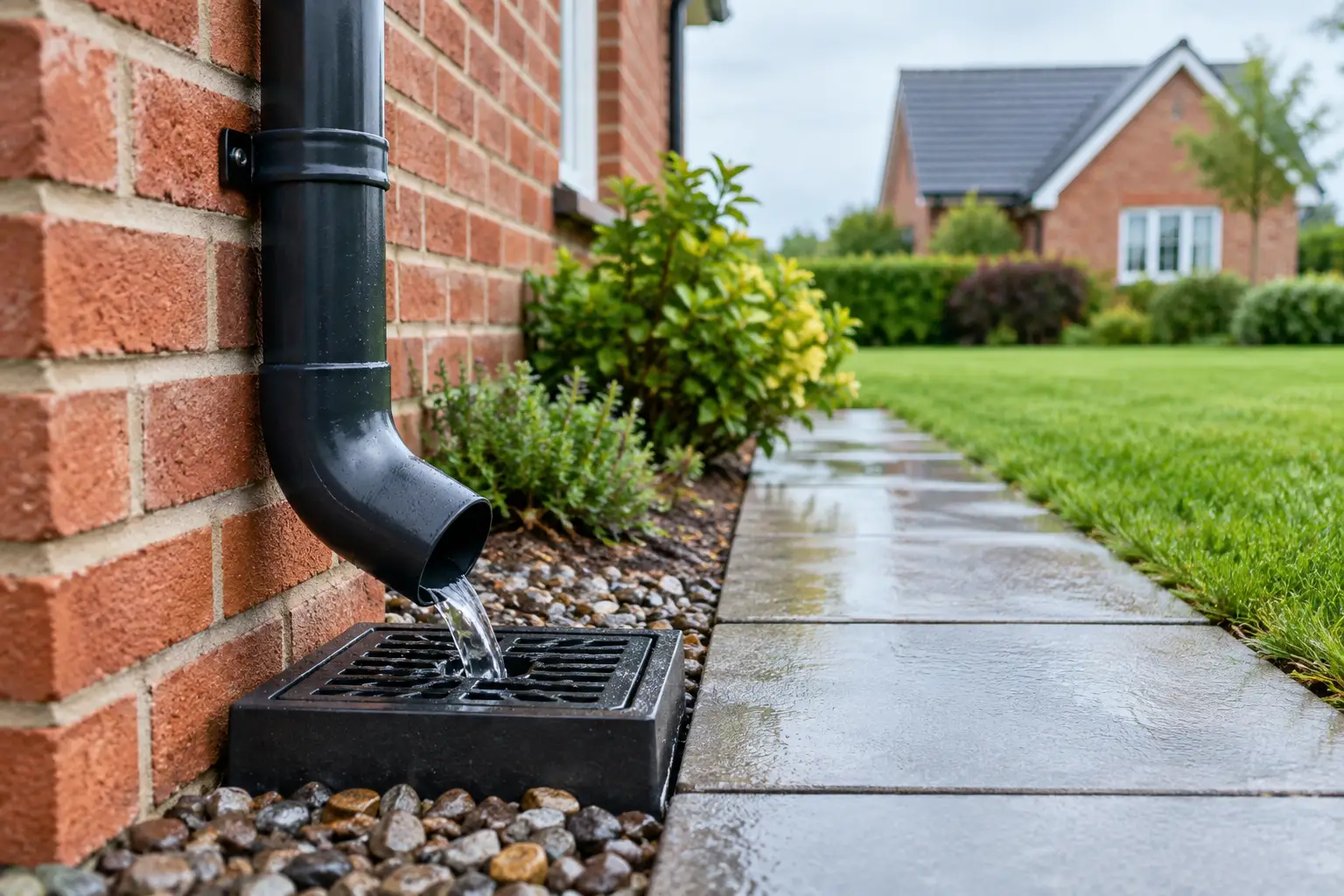
Water running down a roof should leave the property quickly, cleanly and well away from the walls. When it does not, a small guttering fault can become damp masonry, rotten fascias, damaged render or an internal leak. This rainwater drainage system guide explains what a working system should do, where problems commonly begin and when a professional inspection is the sensible next step.
Why roof drainage needs attention
A roof is only as effective as the route water takes once it reaches the eaves. Gutters collect runoff, downpipes carry it to ground level, and drains, gullies or soakaways disperse it safely. Each part depends on the next. A blocked downpipe can make a gutter overflow, while a failed gully can leave water pooling against the foundations.
In the UK, prolonged rain, autumn leaf fall and sudden heavy showers all put drainage systems under pressure. Older properties can present additional issues, including worn cast-iron pipes, undersized guttering, loose joints and ground levels that have changed over time. Properties with large roof areas, extensions or flat roofs may also need more capacity than a standard domestic arrangement provides.
Ignoring overflowing gutters is rarely a saving. Water repeatedly running over brickwork can stain external walls, penetrate defects in pointing and saturate timber at the roofline. On commercial premises, it can also create slip hazards around entrances, loading areas and walkways.
The main parts of a rainwater drainage system
A drainage system does not need to be complicated, but every component must be correctly sized, securely fixed and kept clear. The visible sections deserve regular checks because they reveal problems before damage spreads.
Gutters, outlets and downpipes
Gutters should fall gently towards an outlet so water drains rather than sitting along the run. If the fall is wrong, standing water can accelerate corrosion in metal systems, strain joints and spill over the front edge during heavy rain. Sagging brackets, separated joints and vegetation growing from the gutter are equally clear signs that maintenance is overdue.
The outlet is where water leaves the gutter and enters the downpipe. This is a common choke point for moss, leaves and silt. Downpipes should be firmly clipped to the wall, free from cracks and connected securely at every joint. A downpipe that discharges onto a path or directly at the base of a wall is not managing water properly, even if the gutter itself appears sound.
Gullies, drains and soakaways
At ground level, rainwater may enter a trapped gully, a surface-water drain or a soakaway. Gullies need clear grates and should not retain debris. If water backs up here, the blockage may be below ground rather than in the downpipe.
A soakaway disperses rainwater into suitable surrounding ground rather than directing it into a public sewer. Whether it is appropriate depends on soil conditions, available space, the property layout and local drainage requirements. Clay-heavy ground, high water tables and sites close to buildings can make a poorly planned soakaway ineffective or risky. This is one area where a proper assessment matters more than a quick fix.
Rainwater drainage system guide: assess your property
The easiest time to assess roof drainage is during steady rain. From a safe position at ground level, watch where water is travelling and look for overflow at gutter joints, corners and outlets. You should also check whether water is escaping behind the gutter onto the fascia, cascading down walls or collecting on paving.
Start with the roofline. Missing tiles, cracked slates, defective leadwork or failed flashing can send water behind the guttering, creating a problem that looks like a drainage fault but begins higher up. This is particularly relevant around chimneys, valleys, dormers and flat-roof edges.
Next, follow the downpipe to its discharge point. Water should not pool beside the building after rainfall. Check for staining, green algae, flaking paint, crumbling pointing or a persistent damp patch on the wall. These signs often indicate repeated overflow, even where the problem is intermittent.
Finally, consider what has changed. A new extension, conservatory, roof alteration, patio or driveway can alter the amount and route of runoff. Connecting additional roof area to an existing downpipe may overload it. Raising external paving can also reduce the gap between ground level and the damp-proof course, increasing the chance of splashback and moisture penetration.
Choosing the right drainage solution
The best solution depends on the cause, rather than simply replacing the most visible part. Clearing a blocked gutter may resolve a one-off overflow. Repeated overflow in the same place may require new brackets, corrected falls, a larger outlet or additional downpipe capacity.
For many homes, replacement guttering and downpipes are practical when existing components are brittle, corroded, repeatedly leaking or poorly arranged. Modern systems are available in different profiles and capacities, but appearance should not be the only consideration. A period property may suit a traditional profile, while a large tiled roof or commercial building may need a higher-capacity system designed for greater water flow.
Where water is reaching the ground but not draining away, the issue may lie with a gully, drain run or soakaway. Clearing surface debris is worthwhile, but recurring blockages, foul odours, slow drainage or water rising from a gully call for further investigation. Groundworks should be planned carefully to avoid directing water towards neighbouring land, foundations or access routes.
In some cases, drainage improvements should be completed alongside roof repairs, re-roofs, chimney work or fascia and soffit replacement. Coordinating the work avoids fitting new guttering to defective roof edges or leaving a sound roof above failing drainage components.
Warning signs that need prompt action
Some drainage faults can wait for planned maintenance, but others should be dealt with quickly. Arrange an inspection if you notice any of the following:
- Water entering the property, staining ceilings or running down internal walls.
- Gutters pulling away from the fascia, especially after high winds or heavy snow.
- Persistent overflow that is soaking brickwork, windows, doors or electrical fittings.
- Standing water beside the building, across paths or near entrances after rainfall.
- Cracked, loose or missing roof tiles and slates allowing water behind the gutter line.
Do not climb ladders or walk on a roof to investigate a leak during wet or windy conditions. The immediate priority is to reduce risk inside the building, move belongings away from active water ingress where possible and seek professional help. A drainage issue can be connected to tile and slate damage, leadwork failure or a broader roof defect, so the visible overflow is not always the full story.
Maintain the system before bad weather exposes it
Most drainage failures are preventable with routine attention. Gutters should generally be cleared at least once a year and more often where there are nearby trees, mossy roof coverings or sheltered roof valleys. Autumn is an obvious time, but a check after severe weather is equally valuable.
Keep an eye on brackets, joints and outlet positions when washing windows or carrying out general exterior maintenance. Small drips at a joint can usually be addressed before they become a full separation. Trim back overhanging growth where appropriate, and make sure gully grates remain visible and clear of soil, leaves and gravel.
Landlords and property managers should include roof drainage in planned maintenance schedules, particularly for blocks, retail units, warehouses and older buildings. The cost of routine cleaning and inspection is often modest compared with repairing water-damaged finishes, timber and masonry after a neglected fault.
When to call a roofing and drainage professional
A professional survey is worthwhile where there is recurring overflow, visible roofline damage, signs of damp or uncertainty about where a downpipe discharges. It is also advisable before replacing a complete system, as pipe sizes, roof area, falls and drainage destinations should be considered together.
Armstrong Roofing & Building Limited provides UK-wide guttering, roof repair, leadwork and associated exterior works, with free quotations, no call-out charge and 24-hour emergency support for urgent problems. A clear inspection can establish whether the answer is straightforward cleaning, targeted repair or a wider programme of roof and drainage work.
Rain should be carried away so quietly that you barely notice it. If your property tells a different story through overflowing gutters, damp walls or pooling water, dealing with it early protects both the roof and everything beneath it.