

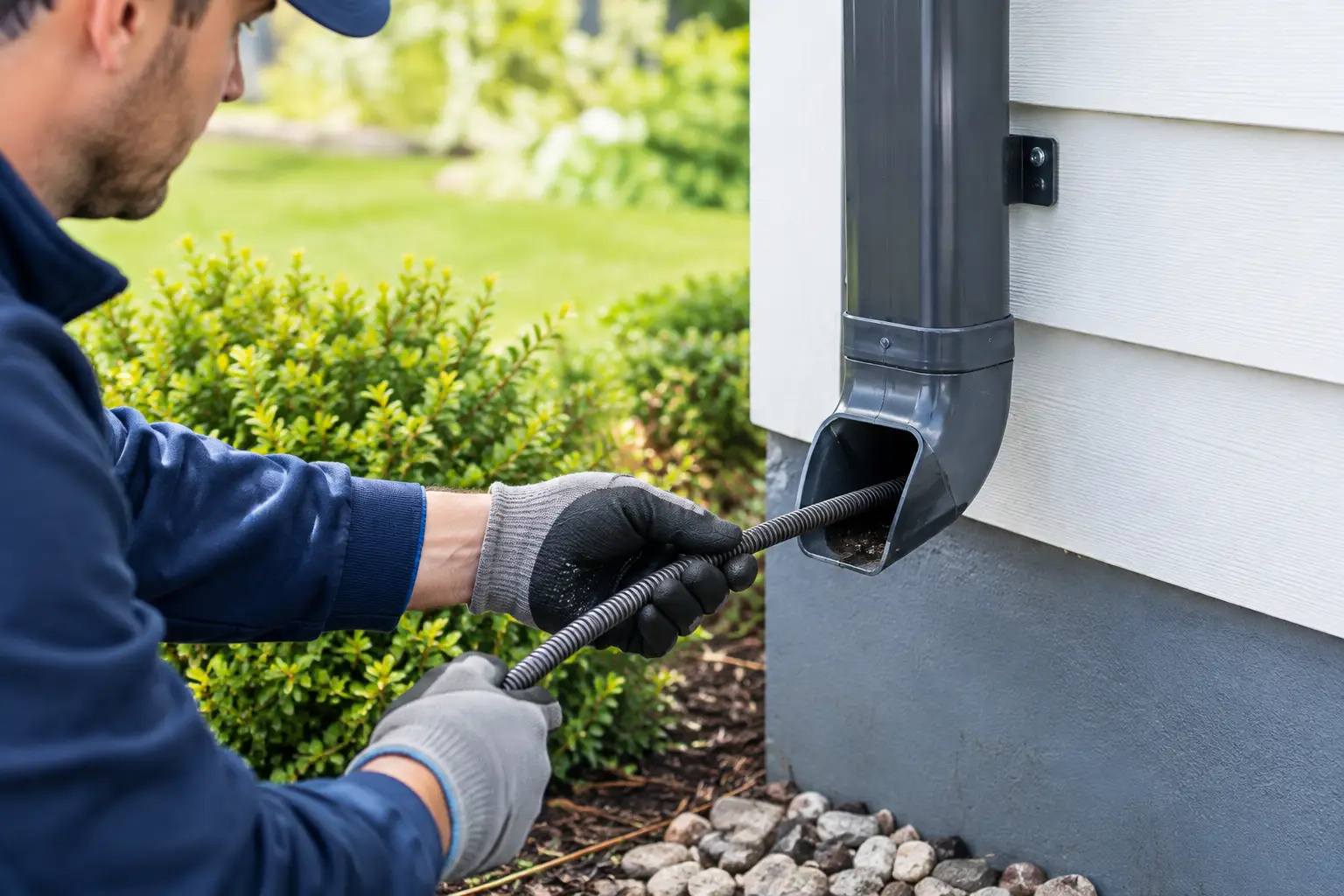
A downpipe that overflows in heavy rain can send water straight down brickwork, across paths and towards foundations. Knowing how to clear blocked downpipes can prevent a small guttering issue becoming damp, staining, damaged render or a leak inside the property. The key is to work safely, clear the right section and recognise when the blockage is a symptom of a bigger drainage fault.
Start with safety, not the ladder
Blocked downpipes are often discovered during a downpour, but clearing one while rain is falling is rarely a good idea. Wet roofs, slippery paving and ladders make routine guttering work unnecessarily dangerous. Wait for dry, calm conditions where possible.
Before starting, assess access from ground level. A pair of gloves, safety glasses, a bucket, a garden hose and a plumber's drain rod may be enough for a straightforward blockage. If the downpipe is high, positioned above a conservatory, or requires you to lean from a ladder, arrange professional help instead. Ladders should be stable, tied where appropriate and used with a second person present. Never step onto a pitched roof simply to clear a gutter or downpipe.
For commercial premises and managed properties, safe access planning matters just as much as the repair itself. Work near entrances, car parks and shared walkways may also need the area below cordoned off while debris is removed.
Check where the blockage is located
Water spilling over the gutter edge does not automatically mean the downpipe is blocked. Gutters can overflow because they are full of leaves, moss and silt, because brackets have failed and created a poor fall, or because the gutter capacity is too small for the roof area.
Look for clues. If the gutter is full of standing water immediately above the downpipe outlet, the obstruction is likely at the top of the downpipe or inside it. If water runs freely to the outlet but disappears slowly at ground level, the blockage may be in the shoe, gully or underground drain. A damp patch or green staining around a downpipe joint can indicate a partial blockage forcing water back through a weak connection.
It is worth checking the gully too. Lift off the grating carefully and remove visible leaves, mud and roof moss. A blocked gully can make a perfectly clear downpipe appear faulty because water has nowhere to discharge.
How to clear blocked downpipes from the top
Start by clearing the gutter around the downpipe outlet. Scoop out leaves, twigs, moss and compacted sediment by hand, placing the waste in a bucket rather than dropping it onto paths or into the drain. Pay particular attention to the outlet itself, where wet leaves often form a dense plug.
Once the outlet is visible, feed a hose into the top of the downpipe and run water gently at first. Do not immediately use maximum pressure. If there is a partial blockage, sudden pressure can force dirty water back over the gutter or separate a loose joint.
If water does not pass through, use a flexible drain rod or purpose-made downpipe cleaning tool. Work it slowly, turning it as you go rather than forcing it. Plastic downpipes can crack if a rigid tool is pushed aggressively, especially in cold weather or where the pipe has aged in sunlight. Withdraw the tool periodically to remove debris, then test again with the hose.
Avoid using harsh chemical drain cleaners. They are unlikely to shift compacted leaves, moss or nesting material effectively, and can create a hazard when the pipe is opened or dismantled. Physical removal and a controlled water flush are normally safer and more effective.
Clear the bottom outlet and shoe
If the top section appears clear but water still will not run away, inspect the lower end of the pipe. The shoe can collect silt, leaves and gravel, particularly where it discharges into an open gully. Remove loose debris by hand and flush the section with water.
Where the downpipe connects directly into a sealed underground drain, do not force rods through fittings you cannot see. The issue may be further along the drainage run rather than in the downpipe itself. Repeated backing up at this point needs proper investigation, particularly if the gully smells foul or water rises from other drainage points.
When it makes sense to remove a downpipe section
Some blockages sit at a bend or joint where a hose and rod cannot reach properly. If the downpipe has accessible clips and safe ground-level access, it may be possible to remove the lower section for cleaning. Take photographs first so you can see how each fitting aligns, and support the pipe before releasing clips.
Clean the section on the ground, inspect it for splits and refit it securely. Make sure each socket faces the correct direction so water cannot escape through the joint. Do not attempt this on old cast-iron downpipes, high-level pipework or installations fixed to fragile render without experience. Heavy cast iron can be difficult to support, while careless removal can damage masonry, paintwork and drainage connections.
In many cases, taking sections apart creates more risk than it solves. A professional guttering repair can clear the blockage while also checking whether the pipe has dropped, cracked or been installed with insufficient support.
Test the full rainwater route
A clear downpipe should be tested from gutter to drain, not only at the point where you removed debris. Run a steady flow of water into the gutter several metres away from the outlet and watch how it behaves. It should travel towards the downpipe without pooling, pass through the pipe without leaking and discharge freely into the gully or drain.
Use this test to check for related faults. Water pooling in the gutter may mean it needs realigning or new brackets. Water escaping from joints can indicate worn seals, distorted plastic or a blocked section below. Water landing beside the gully instead of inside it can saturate the wall base and should be corrected promptly.
If water is entering the property, running behind fascia boards or causing ceilings to stain, treat it as more than a routine cleaning task. Rainwater can travel behind cladding, into roof voids and along timber before it becomes visible indoors.
Common causes of recurring downpipe blockages
Leaves are the obvious cause, particularly near mature trees, but they are not the only one. Roof moss can break away in heavy rain and form a thick sludge at outlets. Birds may nest in open pipes, while loose mortar, broken tile fragments and deteriorated fascia materials can enter gutters after storms.
Recurring blockages can also point to a design or maintenance issue. A downpipe may be undersized for the roof area, a gutter may lack adequate fall, or the outlet may be positioned where debris naturally gathers. Properties with older tile and slate roofs often need more regular gutter clearance because moss and granular debris wash down from the roof covering.
Gutter guards can reduce leaf build-up in the right setting, but they are not maintenance-free. Fine mesh can clog with moss and seeds, and some guards make it harder to see what is happening inside the gutter. The best option depends on tree cover, roof condition and the type of debris regularly collecting around the property.
When to call a roofing and guttering professional
Call for professional assistance if access is unsafe, the pipe remains blocked after a careful flush, or you can see damaged guttering, cracked downpipes or water entering the building. It is also sensible to arrange an inspection after storm damage, when tiles, mortar or branches may have fallen into the rainwater system.
For landlords, property managers and commercial site operators, planned gutter maintenance is usually more cost-effective than responding to repeated overflows. It helps identify failing brackets, deteriorated leadwork around gutters, loose roof materials and drainage defects before they cause disruption or a water damage claim.
Armstrong Roofing & Building Limited provides guttering repairs and wider roofing support across the UK, with free quotations, no call-out charge and a 24-hour emergency response service where urgent water ingress needs attention.
A clear downpipe is a small part of a healthy roofline, but it directs thousands of litres of rainwater away from the building each year. Deal with an overflow early, test the complete route to the drain and do not trade safety for a quick fix at height.