

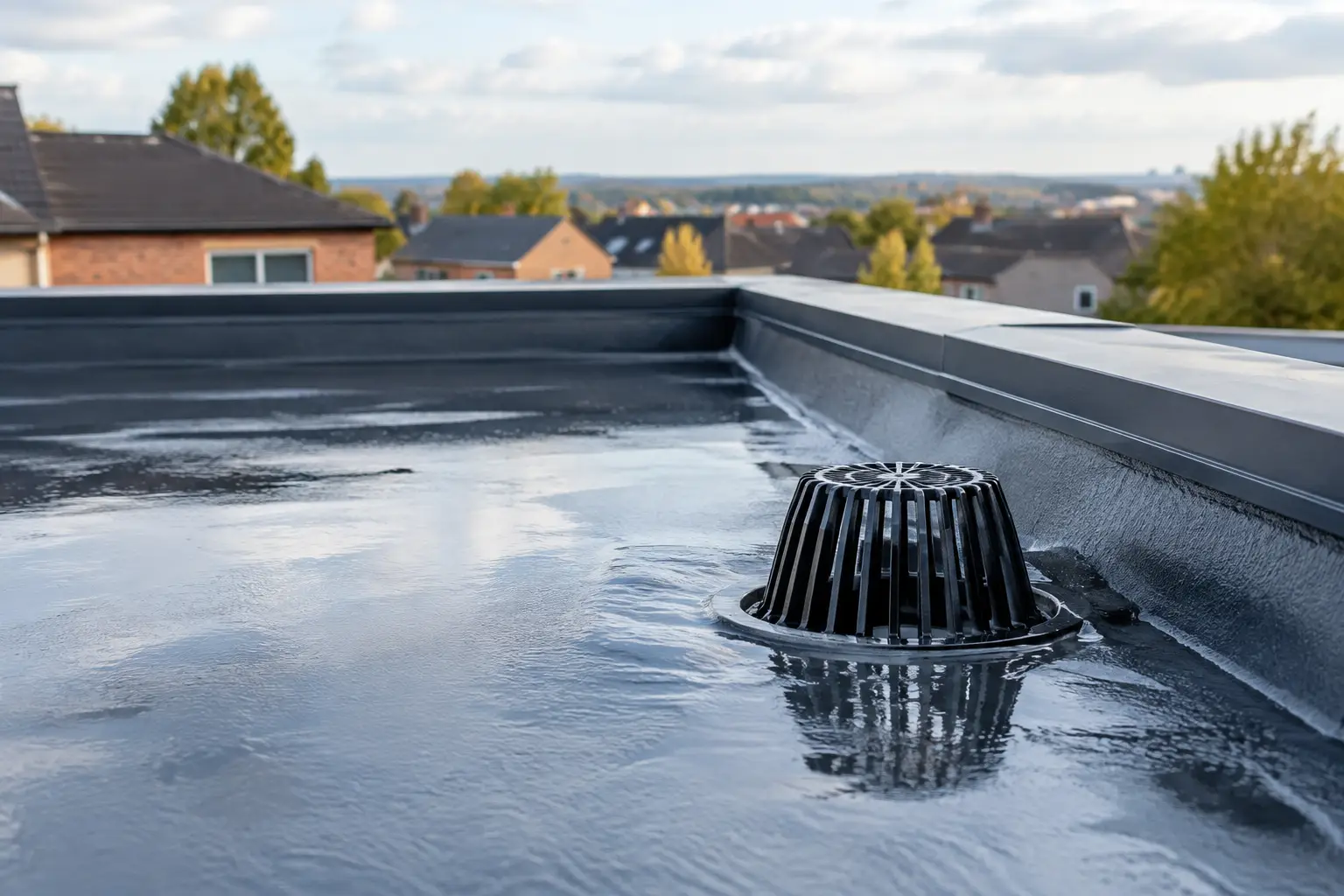
Water should leave a flat roof quickly after rainfall. If it remains in puddles, backs up around an outlet or spills over an edge, the roof covering is being asked to do a job it was not designed to do. This flat roof drainage guide explains what good drainage looks like, what commonly causes failures and when to arrange professional repair.
A flat roof is never truly flat. It needs a planned route for rainwater to travel from the roof surface into outlets, gutters or downpipes. When that route is blocked, poorly formed or damaged, standing water can shorten the life of felt, asphalt, single-ply and liquid-applied roof systems. It can also find its way through laps, flashings and weak points around rooflights, vents and parapet walls.
Flat roof drainage guide: the essentials
Effective drainage begins with falls. A fall is the slight slope built into the roof structure or insulation that directs water towards the drainage point. On many UK flat roofs, a design fall of 1:80 is used, but the finished fall needs to allow for construction tolerances and avoid areas where water can collect. A roofer may therefore design to a steeper fall, often 1:40, depending on the roof build-up and the specification.
The right approach depends on the building. A small domestic extension may drain simply into a gutter along one edge. A larger commercial roof may require several internal outlets, rainwater pipes and emergency overflow provision. Roof size, parapet walls, roof-mounted equipment and the capacity of the existing drainage system all affect the layout.
Drainage is not just about the outlet itself. The roof finish must run cleanly into it, with no raised edges, loose membrane or trapped debris restricting the flow. Downpipes must be clear and suitably sized, while gutters need a reliable fall towards their outlet. One blocked downpipe can leave an otherwise sound roof holding hundreds of litres of water.
Where flat roof drainage problems start
The most obvious warning sign is ponding water that remains for more than 48 hours after dry weather returns. A shallow puddle is not always an immediate failure, particularly on an older roof, but persistent ponding deserves attention. Water adds weight, encourages surface deterioration and makes small defects more likely to develop into leaks.
Blocked outlets are a frequent cause. Leaves, moss, silt, broken roof material and loose chippings can gather around rainwater outlets, especially where nearby trees overhang the property. On commercial premises, packaging, wind-blown litter and debris from plant maintenance can cause the same problem. Clearing an outlet may restore drainage, but the cause should still be checked if the blockage keeps returning.
Poor falls can be harder to spot. They may result from an original installation issue, settlement in the deck, deflection between joists or previous patch repairs that have altered the surface level. Adding new layers of felt over an ageing roof can also obscure the drainage route and create low points around details.
Gutters and downpipes often receive less attention than the roof covering, despite being central to the system. A leaking gutter joint, sagging section, cracked hopper or blocked gully can force rainwater back towards the building fabric. Staining on external walls, damp at the eaves and overflowing water during heavy rain should be investigated before damage spreads.
Choosing the correct drainage arrangement
There is no single best drainage layout for every flat roof. The aim is to create a clear, maintainable route for water and provide a backup route where the consequences of blockage would be serious.
For a roof that drains to an exposed edge, perimeter gutters are often practical and straightforward to inspect. They work well when the gutter has enough capacity, correct brackets and a clear route to the downpipe. On extensions, the junction between the flat roof and the existing pitched roof also needs careful leadwork or flashing so water cannot track behind the gutter line.
Internal outlets are more common on larger roofs and roofs surrounded by parapet walls. They can give a neat finish and protect drainage pipework from the outside environment, but they must be maintained. A concealed blockage may not be noticed until water levels rise. For this reason, correctly positioned overflow outlets or scuppers are particularly valuable on parapet roofs. They provide visible warning that the main drainage is not coping and help prevent water reaching vulnerable door thresholds or membrane upstands.
Tapered insulation is often used to create falls during a warm roof replacement. It can solve long-standing ponding issues without major structural alteration, but it needs a measured design. The insulation layout, outlet positions, rooflight kerbs and perimeter heights must work together. Simply increasing insulation depth without considering finished levels can create awkward details at doors, flashings and parapets.
Routine checks that prevent expensive repairs
A flat roof benefits from inspection at least twice a year, normally in spring and autumn, and after severe weather. Landlords and property managers should also include roof drainage in planned maintenance schedules, particularly for buildings with multiple outlets or restricted roof access.
Look for standing water, debris around outlets, split or lifted membrane, damaged edge trims and vegetation growth. Check that gutters are secure and that water runs freely from the downpipe at ground level. If water is discharging near the building, make sure gullies are clear and not overflowing.
Do not walk on a flat roof unless it has been designed for regular access or a competent person has confirmed it is safe. Older roof decks can be weakened by leaks, and some roof surfaces are easily damaged by foot traffic. A visual check from a window, ladder position or safe access point can identify many issues, while close inspections and cleaning should be left to a roofing professional where risk is involved.
When ponding becomes an urgent issue
Arrange an inspection promptly if water is entering the property, a roof is visibly bowing, outlets are overflowing, or ponding is spreading across a large area. These signs can indicate a blocked drainage route, failure in the roof covering or excessive loading on the structure.
The risk is higher during prolonged rainfall and where a roof has parapet walls with no working overflow. Water cannot simply run off the edge, so levels can continue to rise until they find a weak point. Inside the building, watch for brown ceiling marks, bubbling paint, damp insulation, mouldy odours or drips around light fittings. If water is near electrical fittings, isolate the affected area where safe to do so and seek urgent professional assistance.
Temporary patching is not always the answer. If the underlying problem is a failed outlet, incorrect fall or deteriorated deck, surface repairs alone may only divert water elsewhere. A proper assessment should identify whether the roof needs local repair, new outlets or gutters, improved falls, leadwork repairs, or a complete re-roof.
Repair or replace?
A local repair can be cost-effective when the roof covering is generally sound and the drainage fault is confined to a blocked or damaged outlet, split seam, failed flashing or isolated low point. Clearing and repairing gutters, renewing a rainwater outlet or reinstating the membrane around a detail can stop a leak before it becomes a wider problem.
Replacement is often the more sensible long-term option where there are repeated leaks, widespread ponding, brittle felt, failed previous patches or signs that water has affected the deck and insulation. During a re-roof, the drainage design can be corrected rather than repeatedly managed. This is also the right time to review overflow provision, gutter capacity and the condition of connected downpipes.
For commercial properties, planned drainage improvements can reduce disruption and protect stock, equipment and tenant spaces. For homeowners, acting before ceiling damage appears is usually less expensive than dealing with wet insulation, internal redecoration and timber repairs later.
If your flat roof is holding water or showing signs of a leak, a clear inspection and written scope of work are the best next steps. Armstrong Roofing & Building Limited provides free quotations, no call-out charges and 24-hour emergency support for urgent roof drainage and repair issues across the UK.